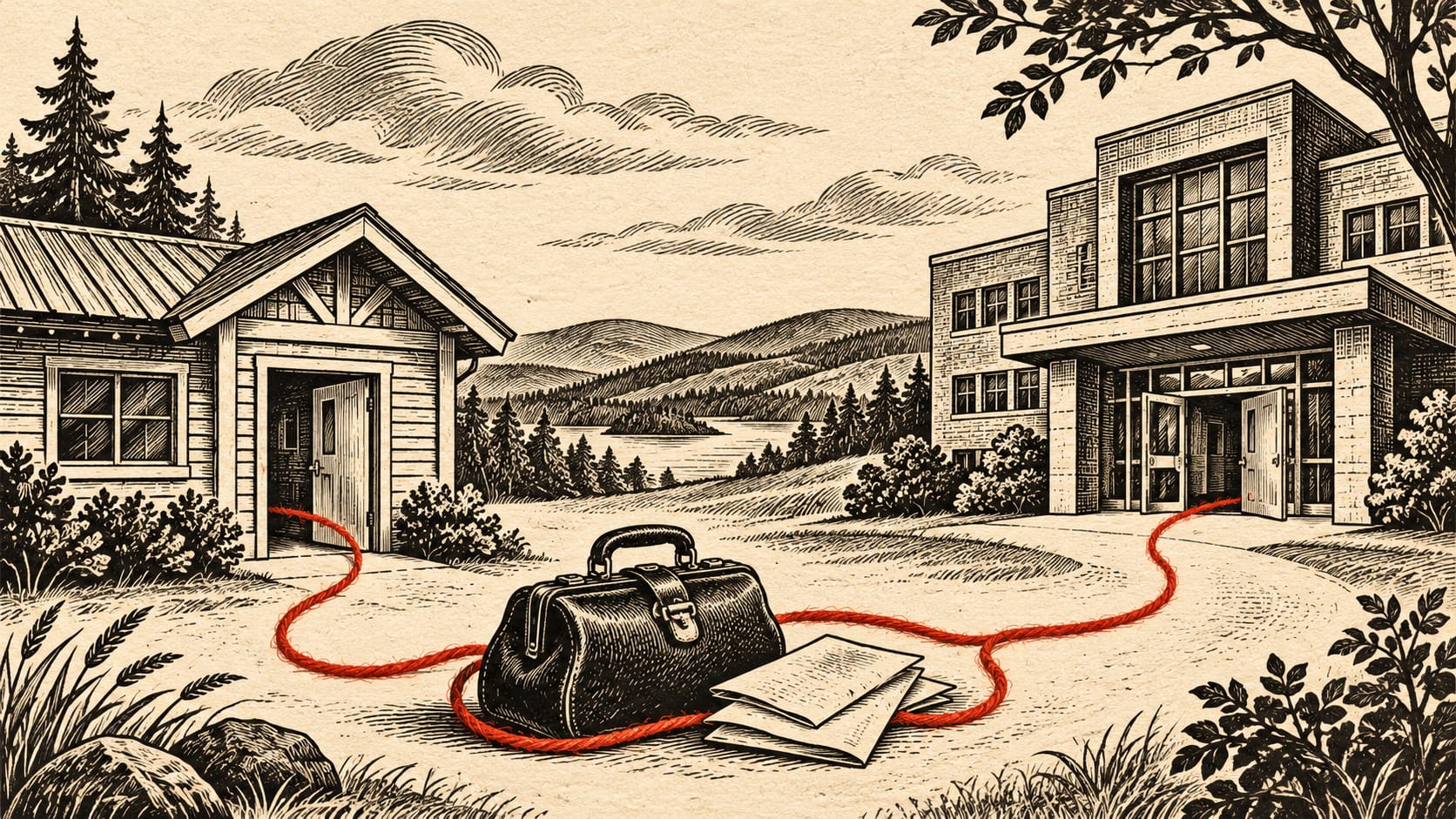
A doctor considering temporary work in rural British Columbia can weigh a concrete offer: a guaranteed minimum payment of $1,275 per 24-hour assignment day, rising to $1,658 with applicable community premiums, plus eligible travel and accommodation support. The Rural Family Practitioner Locum Program pays doctors to cover colleagues’ absences. A locum is a physician taking a temporary replacement assignment. Accepting one requires time, appropriate skills and a workable trip, as well as a provincial licence. ()
That decision sits at the centre of New Brunswick’s proposal at the first ministers’ agenda meeting. Its delegation sought faster licensing for nurses and other health workers moving between provinces, national expansion of Atlantic Canada’s physician registry, and stable funding reflecting an ageing population. Saskatchewan emphasized rural physician recruitment funding and provincial spending flexibility. Nunavut stressed healthcare infrastructure and the disruption when elders travel south for treatment. Their priorities meet where an available clinician decides whether to take an available job. Physicians offer one test of that broader proposal.
Physicians have different reasons for doing temporary work. A study of 152 Alberta family medicine graduates with locum experience found that nearly half named gaining experience as their main reason; about a fifth chose lifestyle options. Almost a quarter had combined locums with full-time practice. These were early-career doctors surveyed in 2006–07. ()
When paperwork matters
For an interested doctor, administration can change the decision. In its June 2025 response to the Atlantic Registry evaluation, the Society of Rural Physicians of Canada described one of its authors giving up a licence because maintaining it was too burdensome. After the registry began, the physician returned to that jurisdiction for several locum visits. The society, which advocates national licensing, offered a concrete account of work resuming after the rules changed. ()
The Atlantic Registry simplifies licensing across the region’s four provinces. Its March 2025 evaluation also records the opposite experience: a respondent said they would do no further locums outside Nova Scotia because credentialing and billing remained burdensome despite easier licensing. Other physicians described sufficient work at home, travel and family commitments. ()
Coverage could still be valuable. A Nova Scotia participant described specialty call coverage for Newfoundland and Labrador that gave colleagues weeks off: “It’s been a game changer I think for them.” () Such relief gives existing staff a break while maintaining a service.
The evaluation reported 385 participants holding more than 900 additional licences. Separately, early billing records covering only three provinces identified 41 instances of new cross-border practice; a physician could be counted in more than one province. The evaluators judged the likely regional access benefit a “poor return on investment,” citing limited mobility and regulatory work spent issuing unused licences. They recommended improvements. () The individual accounts explain why easier registration can unlock wanted work while other obstacles still discourage participation.
A licence establishes eligibility. Turning it into useful coverage also requires a willing clinician, a feasible assignment and a service patients need. BC’s programme already helps arrange placements and travel, while hosts specify the clinical skills required and provide patient-care information. ()
Saskatchewan illustrates how much is involved in that offer. Northern Medical Services advertises a one-year renewable floating locum contract with two weeks in and two weeks out, a $2,102 daily rate plus an on-call stipend, a transportation allowance and housing. Saskatchewan licensing eligibility is required. () This is a recurring work arrangement, with compensation and logistics built in. The delegation’s call for recruitment funding concerns those conditions. Simpler licensing could widen the pool able to accept them.
Nunavut’s physician recruitment service advertises flexible locum contracts with travel and housing covered. () Yet its 2023–26 health action plan identified workforce shortages, fly-in access and limited housing as obstacles to rapid deployment. () Paying for accommodation and having a suitable place available are distinct requirements. The territorial delegation’s infrastructure concerns therefore remain consequential even when a doctor is willing and licensed. Whether an incoming clinician can reduce medical travel also depends on which treatments can be provided locally.
Visiting or moving
The price of mobility depends on how often a doctor uses it. The Atlantic Registry charges $500 annually on top of the home province’s licence fee. Saskatchewan lists a $525 application fee and a $455 monthly licence option for periods up to four months, with initial-registration charges separate where applicable. (; ) A single short assignment has fewer paid days over which to spread entry costs. Repeat visits spread them further, while annual fees keep the decision alive each year.
A permanent move has a different horizon, and existing recognition routes already reduce some entry costs. Nova Scotia waives application, registration and the first calendar year’s annual licence fees for eligible physicians with full, unrestricted Canadian licences entering long-term practice. Its streamlined review usually takes one to three business days once all documents arrive. (; ) Further reform has less fee removal to offer on that route than a general promise of easier mobility suggests. Collecting documents and securing hospital privileges or liability coverage can still affect when work begins.
Delay matters differently from the fee itself. A late licence can rule out a fixed week of cover; for someone already committed to relocating, it may postpone the start of a job. A doctor who continues practising in two provinces must maintain the necessary registrations, while one who leaves a practice entirely may no longer need the old licence. Ontario’s automatic-recognition route does not require physicians to retain their previous licence. ()
The destination itself reflects more than registration. Mou and Olfert’s study of 3,995 family physicians, using the 2010 National Physician Survey, found that rural Canadian-trained doctors’ intentions to leave varied with community size. Among rural internationally trained doctors, distance from an urban centre and relative provincial remuneration mattered. () Simpler registration changes the cost of accepting an offer; it does not supply the professional support or community opportunities that help make the offer attractive.
For a national agreement, the practical opportunity is to connect simpler registration to the locum programmes provinces and territories already use. A community with few doctors and a specific gap in its schedule could recruit from a wider pool if interested physicians could clear a licensing obstacle to a funded assignment. Saskatchewan’s pay and travel arrangements illustrate how to make the visit feasible; Nunavut’s housing constraints show why the local setting still determines what can be delivered. Coordinating recruitment, credentials and handovers around those assignments would give professional mobility a direct purpose in maintaining services.
The payoff can be more reliable care without a rise in national clinical hours. Cover for a resident doctor’s leave can keep care available locally; where visits draw time from another practice, coordination must account for those patients too. Keeping physicians permanently involves the appeal of the jobs and communities themselves. New Brunswick’s proposal could be most useful where simpler rules help existing staffing programmes turn an identified need and a willing clinician into reliable care.